
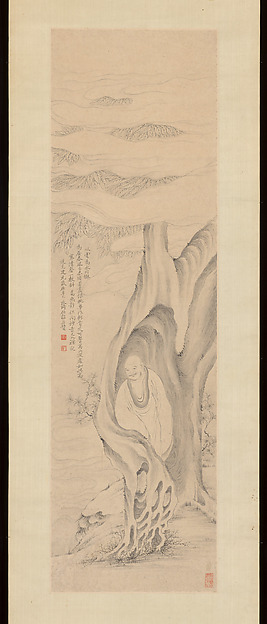
Luohan Meditating in a Tree, 1821
Artist in the Global Art Registry
Gai Qi
1774–1829 · Qing dynasty
- Born
- 1774
- Died
- 1829
4 works in the Collect24 Registry
Every work carries a permanent Collect24 Art ID, the way a book has an ISBN.
Gai Qi, also known as Bowen, Qiliang, and Yuhu Waishi, was a poet and painter born in western China during the Qing dynasty. Active in Shanghai, he primarily painted plants, beauty, figures, and landscapes, often adding rhyming ci poems to his works.
Read full biography
Gai Qi (Chinese: 改琦; 1774–1829), courtesy name Bowen (伯蕰), art names Qiliang (七郎) and Yuhu Waishi (玉壶外史), was a poet and painter born in western China during the Qing dynasty. As an artist, he was active in Shanghai. His paintings mainly concerns plants, beauty, and figures. However, he also did numerous landscapes. In poetry, he preferred the rhyming ci form and added such poems to his paintings. His social circle included prominent literati as well as artists. He organized both a literary society and a Buddhist lay society. His work often used a delicate baimiao (outline) style, which can be clearly seen in his illustrations for the novel, Dream of the Red Chamber. The illustrations are chiefly portraits of the main characters in the novel. Numerous poets, including the renowned woman poet Zhou Qi, wrote poems to accompany the illustrations. The scholar Wang Qisun (王岂孙) commissioned Gai Qi to paint an album of famous Chinese women, both historical and legendary. Wang's second wife, Cao Zhenxiu, wrote poems about the women and produced the calligraphy in the album. Gai took as a student the talented woman painter and poet Qian Shoupu (錢守璞) (c. 1801–1869). He was associated with the painter Fei Danxu in what has been called the "Gai Fei" school. Gai's grandson continued the tradition of the Gai Fei school, along with the descendants of Fei Danxiu. He is perhaps best-known today for the Hongloumeng tiyong, a book of portraits of characters in the Dream of the Red Chamber, accompanied by poems about the characters. Gai's work is held in the permanent collections of many museums worldwide, including the Metropolitan Museum of Art, the Los Angeles County Museum of Art, the Johnson Museum of Art, the Palace Museum, the British Museum, the University of Michigan Museum of Art, the Museum of Fine Arts, Boston, the Princeton University Art Museum, and the Indianapolis Museum of Art.
Biography source: Wikipedia · CC BY-SA 4.0
Unclaimed estate profile
This profile was built from publicly available information. Nobody representing the estate of Gai Qi manages it yet. If you represent the estate or foundation, claim the profile to control the biography, portrait and registered works.
Claim this estate profileSpotted something incorrect? Sign in to suggest an edit — our editors review every change.
4
Registered works
4
In museum collections
0
In gallery collections
0
In private collections
Featured works
Selected registered works by Gai Qi
Selected from 4 works by Gai Qi in the Collect24 Registry.
Gai Qi
Luohan Meditating in a Tree, 1821
Hanging scroll; ink on paper
111 × 32.5 cm
The Metropolitan Museum of Art
C24-131153
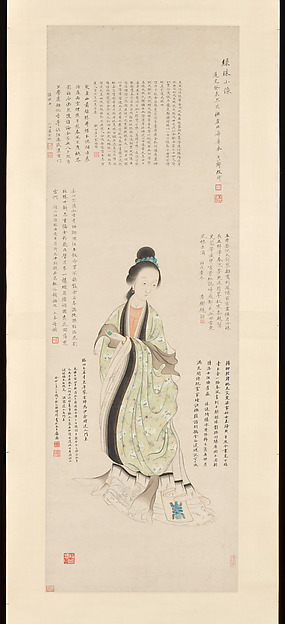
Gai Qi
Small portrait of Luzhu, 1823
Hanging scroll; ink and color on paper
128.3 × 43.8 cm
The Metropolitan Museum of Art
C24-127376
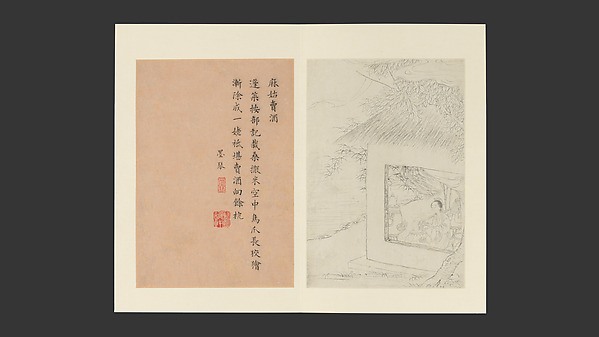
Gai Qi
Famous Women, dated 1799
Album of sixteen leaves; ink on paper
24.8 × 16.8 cm
The Metropolitan Museum of Art
C24-103783
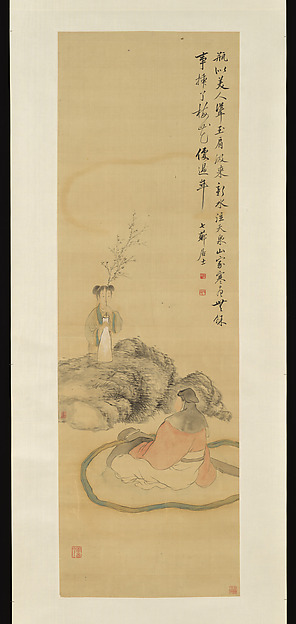
Gai Qi
Girl Arranging Flowers
Hanging scroll; ink and color on silk
103.8 × 33.3 cm
The Metropolitan Museum of Art
C24-130109
Gai Qi 改琦
Farewell to Spring Briar Roses, early 19th century
Hanging scroll; ink and light color on silk
Harvard Art Museums
C24-120248
Museums and collections
Where works by Gai Qi are registered
- The Metropolitan Museum of Art
New York, United States
4 works
Registry catalogue
Search all 4 works by Gai Qi
The complete catalogue lets you search by title, year, collection, medium or Collect24 Art ID, and filter by period, medium and collection.
Open the full catalogue →Artists from the same period
Artists born around the same time
- Dai Xi
1801–1860
4 works
- Zhu Angzhi
b. 1764
4 works
- Tang Yifen
1778–1853
3 works
- Su Liupeng
1796–1862
3 works
- Pan Simu
1756–1839
3 works
- Wang Xuehao
1754–1832
2 works
- Yang Tianbi
1796–1850
1 work
- Xie Lansheng
1760–1831
1 work