
After the reflection VI (a) | Artworks | Mennour
2025
- Medium
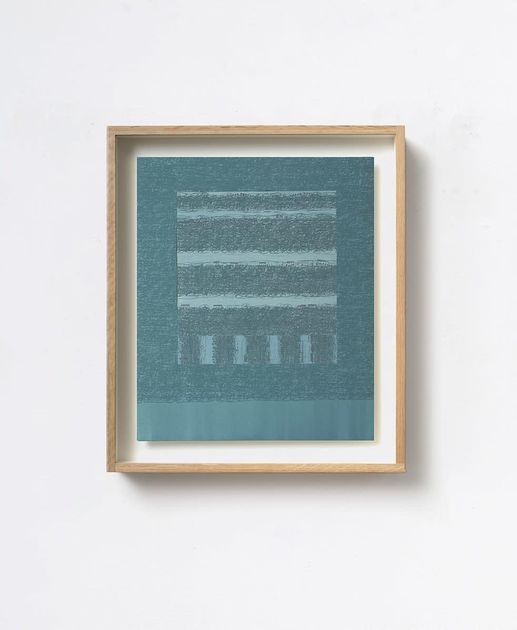
- Huile et encre sur papier / Oil and ink on mounted paper
- Dimensions
- 47 × 39 cm
- Status
- In Gallery Collection
- Collect24 Art ID
- C24-188645
“After the Reflection” by Idris Khan is a meditative exploration of memory, perception, and time. Inspired by Monet’s Green Reflection , the work dissects the painting’s essence through a grid of ten monochromatic watercolour collages. Each panel draws its hue from the original’s vivid palette, creating a harmonious yet fragmented echo of Monet’s vision. Layered over these translucent washes are dense strata of musical notation—scores chosen for their resonance with Khan’s emotional response to the painting. As the notations are repeatedly superimposed, they coalesce into an intricate palimpsest, blurring the line between melody and noise, structure and chaos. The result is a visual and sonic cacophony, where meaning is both constructed and obliterated. Through this almost scientific process of deconstruction and reconstruction, Khan challenges the viewer to reconsider how memories are formed, transformed, and ultimately reimagined. The centerpiece of “On Reflection,” a grid of monochrome watercolors collectively titled After the Reflection , is a deconstructive study of ‘Reflets verts’ ( Green reflections ), one of the eight murals in Claude Monet’s suite of water lilies at Paris’ Musée de l’Orangerie. Khan began by extracting what he feels are that painting’s thirty most important colors, then used a synthesizer to generate a sound profile of its gradations and modulations. A musical transcription of that sound supplies the notes stamped on the surface of each watercolor, on top of which sit collages made from actual sheet music—evoking Khan’s late mother, who loved to play the piano in a small music room whose floor was often covered with paper scores. Colors selected and sampled from Monet’s mural also underpin another series of monochromes that introduce a new technique and a new materiality: instead of stamping words, Khan uses a type-mounted roller, a hybrid of letterpress printing and Buddhist prayer wheels, to move oil paint around the canvas, sometimes scraping away to reveal the acrylic coat underneath. The result is necessarily messier, the lines earthier and more askew, than the orderly spacing and margins of the stamp paintings. “It’s much more expressive and fast,” Idris Khan explains. “You’ve only got a few hits until it goes too far.”
Registered on Collect24
The identity of the collector is never published. Purchase information, documents and the exact location of the artwork remain private.
Record from a public source
This record was created from publicly available information on Mennour’s own website. The gallery does not manage this listing yet. If you work at Mennour, claim the profile to manage this work — its images, details, availability and provenance.
Claim this galleryAuction history
Public sale records matched to this work. Ownership is never disclosed.
Loading sale records…