

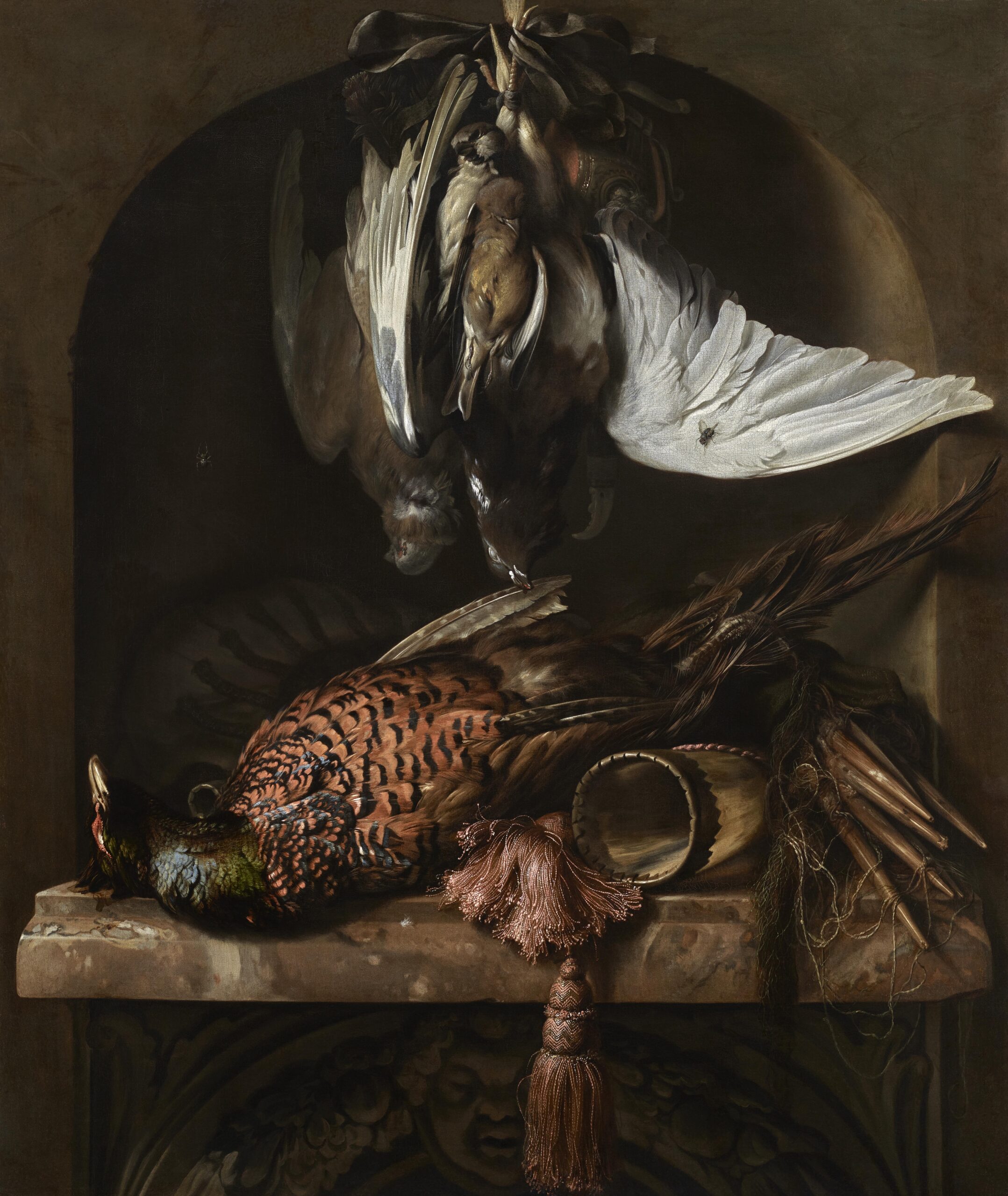
A Still Life with a Pheasant on a Ledge and a Partridge, a Pigeon and two Finches tied together with a Bow - Rafael Valls
probably from the 1680s
- Medium
- Oil on Canvas
- Status
- In Gallery Collection
- Collect24 Art ID
- C24-149686
Jan Weenix was born in Amsterdam but began his career as a pupil of his father, Jan Baptist Weenix, in Utrecht. He is known to have worked with his cousin Melchior d'Hondecoeter, who was also a pupil of Jan Baptist, and both were to influence each other a great deal. From 1664 to 1668 Jan is recorded as working at the Painters' Guild in Utrecht. It is thought that he settled in Amsterdam in around 1677. In 1679 he married Pieternella Backers and together they had 13 children. It was at this stage in his career that his reputation as a still life painter began to gain him a great deal of work. His appointment as court painter to the Elector Palatine, Johann Wilhelm, in 1702 was the high point of his career. The twelve vast canvases painted for the Elector's Bensberg Castle in 1712 and 1714 are among his masterpieces. Jan also became known for his Italianate landscapes, which drew much influence from his father. However, it is his balance of the two genres, landscape and still life, which sets him apart from his contemporaries. His large canvases were invariably to form part of major interior decorative schemes in many of the important houses of the nobility at the time. The present picture is a newly discovered work by Jan Weenix. Anke Van Wagenberg-Ter Hoeven's catalogue raisonné on the artist lists eleven game still lifes on tables or in niches by or attributed to the artist. All of these feature dead hares which makes the present work, with its wonderfully iridescent pheasant, rather distinctive in the group (though pheasants feature more commonly in Weenix's outdoor scenes). The stone niche with its leering face also appears to be unique. Wagenberg-Ter Hoeven writes that after the mid-seventeenth century the style of game still lifes in the Netherlands changed to become vertical compositions with the game displayed as prized hunting trophies rather than as an object in a kitchen or pantry surrounded by vegetables. Over the latter decades of the century the game piece became increasingly sophisticated with beautiful and extravagant hunting paraphernalia. Weenix matured and thrived in this genre confidently painting the feathers, velvets, metals, nets, horns and furs of his subjects in a rich and lustrous palette. Dr. Fred G. Meijer has fully endorsed the attribution of this work to Jan Weenix on the basis of photographs. Dr. Meijer describes it as '...an excellent example of a relatively early work by Jan Weenix, probably from the 1680s.'
Registered on Collect24
The identity of the collector is never published. Purchase information, documents and the exact location of the artwork remain private.
Record from a public source
This record was created from publicly available information on Rafael Valls’s own website. The gallery does not manage this listing yet. If you work at Rafael Valls, claim the profile to manage this work — its images, details, availability and provenance.
Claim this galleryAuction history
Public sale records matched to this work. Ownership is never disclosed.
Loading sale records…